
- The DF-1 woven wire mesh pattern is a classic Dutch style weave that uses bright embossing technology applied to traditional flat top cross wires producing a beautifully faceted cladding product. Because the facets only deviate slightly from the plane of the fabric, very interesting reflective patterns develop at a near-perpendicular viewing perspective. This is an asymmetric fabric.The DF-1 mesh pattern is an opaque weave that is typically affixed to a rigid backer panel for vertical and horizontal surfacing. The DF-1’s unique strength and beauty makes this mesh a good choice for elevators, lobbies, airports, and retail environments.
- The gentle, flat wire undulations combined with straight wire produces a robust, symmetric, opaque fabric with soothing qualities. Ideal as cladding for all types of vertical and horizontal surfaces, it defines and protects with style. Mixing the wire alloys creates a subtle mixture of metallic tones. This wire mesh pattern is asymmetric both front and back.
- Strong flat top crimp design suitable for all applications. The F-48 Mesh: Diameter ratio along with the typical Flat Top weave characteristics, creates a mesh with a heavy surface mass.Flat top weaves can be scaled and customised to suit many different functions. From fine spacings and diameters to coarse and heavy diameters. Rectangular patterns are easy to create as well to achieve a desired aspect ratio.
- Strong flat top crimp design suitable for all applications. The F-48 Mesh: Diameter ratio along with the typical Flat Top weave characteristics, creates a mesh with a heavy surface mass.Flat top weaves can be scaled and customised to suit many different functions. From fine spacings and diameters to coarse and heavy diameters. Rectangular patterns are easy to create as well to achieve a desired aspect ratio.
- The FPZ-16 architectural wire mesh pattern is a large scale mesh that is suitable for all types of architectural applications. From railing infill panels to large span parkade panels, the FPZ-16 is strong and adaptable to many different design budgets.
- Flat top warp, and plain crimp fill creates this large scale mesh that is suitable for all types of architectural applications. From railing infill panels to large span parkade panels, the FPZ-16 is strong and adaptable to many different design budgets.
- The I-188 is one of the more basic wire mesh constructions, the simple intercrimp weave is very versatile and can be woven from a huge variety of alloys. The wires are in constant motion to create a zigzag appearance.
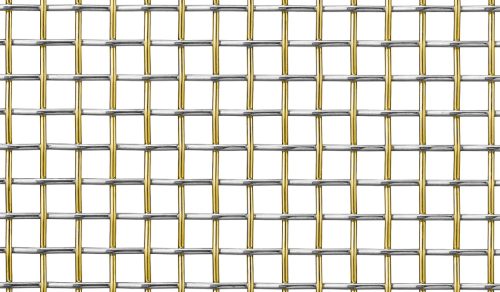
- The contemporary look of high-definition Lock Crimp, together with traditional square mesh design. The L-62 readily interfaces with all types of structures, economical and classic.Lock Crimp weaves are highly scale-able in either square or rectangular, fine scale to large. Call us so that we may explain your design options.
- The L-81 woven wire mesh pattern is an economical, robust multi-purpose weave that can be manufactured from a wide range of alloys. Banker Wire’s large selection of Lockcrimp tooling makes it possible to offer hundreds of square or rectangular lockcrimp spacing and diameter combinations. You have plenty of options. Please call to discuss.
- The Banker Wire L-196 is a Lock crimp woven wire mesh specification. This square weave can be woven in a variety of alloys including: Stainless Steel, Plain Steel, Weathering Steel, Pre-Galvanized Steel, Galfan, Brass, Bronze, Copper, Aluminum, Stainless Steel/Brass, Stainless Steel/Bronze, Stainless Steel/Copper.
- L-441 is a small scale Lock crimp wire mesh pattern that can be woven in a wide range of alloys available. This lighter scale pattern is great for interior spaces or for applications looking for a delicate look.As with all of our Woven Mesh products, the scale of the mesh can be adjusted to suit the look and function required. Please call for more information.
- Based on the Golden Ratio, Banker has created this simple, high definition rectangular lock crimp pattern to form a Golden Rectangle.The LZ-55 woven wire mesh specification is a perfect balance of spacing and diameter for its use in many architectural applications where strength and high percent open area is of importance.
- The Banker Wire M22-28 woven wire mesh pattern is a small scale twin wire intercrimp pattern that would accent any interior space. Available in many alloys, the Bronze wire as shown in this crimp style just sparkles.
- The M22-37 wire mesh pattern a scaled down version of the popular M22-27. This all purpose twin wire lock crimp pattern can be woven in all alloys for any application.
- M22-43 is a mid scale, heavy duty wire mesh pattern where 2 individual wires share the same crimp pocket. A flared out diamond shaped facet at the intersections creates the unique detail. A very robust weave, this mesh pattern can be used for just about any application.
- The Banker Wire M22-80 architectural wire mesh pattern uses a pair of nested helical crimped wires to define the circular mesh shape. A larger scale version of M22-83, the unique reflective surfaces of the circle mesh is doubled in perfect unison.The double wire pattern adds strength to this weave and is a great option for railings, screen walls, space dividers, signage, plus many other interior or exterior design applications.
- The Banker Wire M22-83 architectural woven wire mesh pattern uses a pair of nested helical crimped woven wire to define the circular mesh shape. The unique reflective surfaces of the circle mesh is doubled in perfect unison. This pattern is slightly smaller in scale than the larger M22-80.The double woven wire pattern adds strength to this weave and is a great option for railings, screen walls, space dividers, and signage, plus many other interior or exterior design applications.
- A true basket weave! Three separate crushed wires make up the appearance of flat bands and gives it a three-dimensional shape. Low percent open area qualities give this material great cladding or visual screening possibilities.Created by one of the Weavers in the shop, this design is sure to be a classic. Consider this mesh pattern with a decorative plating finish to bring out its full texture.
- Contemporary high definition lock crimp weave with a 4.5 inch square repeat pattern. A beautiful consistent repeat pattern emerges when seen over a larger area. A perfect inexpensive railing infill or parking garage material that can be woven in a wide variety of alloys.
- A simple over-under pattern using 4 independent wires that share the same crimp pocket. Thin and strong, this wire mesh creation has unlimited design applications as either interior or exterior. At 34 percent open area, this unique weave exhibits an interesting light and shadow pattern making it a good choice for sunscreen or light diffusing applications.
- Simple and delicate in appearance, the P-286 is a plain crimp weave that will forever be a classic.
- The S-16 architectural woven wire mesh pattern is a classic weave that will warm up any interior space. Developed specifically for copper based alloys, the highly specular surface of this material gives it a chameleon quality wherein it takes on the colour of its surroundings.S-16 wire mesh pattern is offered as a standard in a bare Copper, Bronze or Brass. While the wire used is brightly drawn and consistent in colour when we start the weaving operation, the finish is bare and is subject to tarnish over time. If preferred, Banker Wire does offer secondary finishes like US10A and Us10B to either preserve the colour with a lacquer top coat or, darken the finish.
- The S-30 flat wire weave is a plain crimp that has soft bends like a basket weave. The reflective flat wire attracts light and colours from its surroundings and gives it back in a unique way only woven metal can.This robust 1/4″ wide flat wire is substantial and can be used in applications where strength is needed such as railing infill panels and room dividers.
- The S-32 is a simple, small scale, flat wire woven wire mesh pattern. The smooth and gentle shape of the wires weave in and out from each other to form a basket style mesh. Using a flat wire instead of a traditional round wire at this spacing provides a mesh with a lower percent open area.




metal solutions


© Copyright 2026 | Website designed and built by Wired Creative | All Rights Reserved | Amron Architectural
